Repair

Perhaps the single most important word in a learning parent's lexicon...
While I am busy destroying the idea that 'kids just need to cry sometimes' as unnecessary cruelty, I will gleefully declare that repair is a natural and necessary part of any relationship...
Because relationships are messy.
Everyone has their own perspective, and a storyline in their mind explaining 'what is really happening now' which may or may not have any contact with reality, much less having anything in common with the storyline in the mind of the person facing them, or anyone else, ever in the history of everywhere... which leads to ... complications.
Feelings. Reactions. Bigger feelings. More reactions.
It's not a great pattern, but sometimes it's very, very difficult to see a way out of it from the front. So, when a parent is left at the back of an interaction that got... hectic ... there are important steps to take.
Adult steps.
The 'bigger person' steps.
Step One
Starting with climbing down off the Adults Are Always Right pony.
Yes, I know, they always were when you were a kid and now it's your turn... but they weren't either, and it has to stop somewhere. It might as well stop with you, instead of your kids...or grandkids ... or never.
To be clear: the adults of our childhoods – including yours– were routinely, frequently, often extremely consistently wrong. And they also knew it – maybe not in the moment, but they knew it. They may never admit it, but they knew. Watch how they hot-react to modern, sensitive and caring parenting. That snippy and nasty attitude comes out of ego protection, not the quiet certainty that they were never wrong and this generation will figure it out, too.
People who are actually right are often astonishingly quiet about it. Something in the Dunning-Kruger Effect about that: the more certain and proven someone's understanding of the world, or any single subject, is, the quieter and less dogmatic they become about it, while the people who aren't sure about their righteousness need to shout it from the rooftops...
Anyhow... back to the steps...following getting off that pony:
Step Two
Talk about the impact your... reactivity... had on your child:
"You felt so panicky and scared when you heard me shouting, and saw my angry face..."
Then, and this is the tricky bit...
Step Three
....stop... talking.
Wait.
Think of this as repairing something. Hammering away at it is unlikely to fix it. The glue needs to set. It takes a while...
Now, this might result in a flood of tears (maybe even from both of you) ... and that's good.
I don't mean 'good' in the sense, above, that 'kids need to cry.' But good in the sense that emotions that are released are out. When they're released in compassionate company, with no rush to fix them or stop them, or 'calm' them, they run out. They end. They're done.
If they don't cry (whether or not you do) that's also okay. Not every feeling has tears.
Step Four
Whatever they say next, listen. Don't argue. Don't justify your reaction with any kind of explanation. Really do not deny what they say. What comes out is very likely to be immature, dramatic, overstated, even outrageous. Again: good.
Not 'good' as in 'gee, it's great that they're immature, dramatic, outrageous...' but rather, 'good, they're telling you the truth about how they feel' even if it comes with words you'd rather they didn't know, or hurtful ideas. This is about their emotions not their considered opinions.
"I hate you, you're the worst adult in the world and you never loved me!" is not literal. It is the only way they can think of expressing the depth of their rage, disappointment, shock or annoyance at how the most important people in their world have let them down.
Yes, even in an argument over socks, a cookie, or going to swim class.
One of the things adults are the most likely to forget is how high colour, huge magnitude, and overwhelmingly life-altering being mad at the people kids need on their side to survive feels to kids. Kids don't have mild, little kid-size emotions like 'sad, mad, glad' pretty much ever, but especially not when it involves the instinctive terror and wrongness of mad adults.
A key point:
A relationship cannot be repaired if one person cannot express how they really feel, especially not when they have to protect the feelings of the other to remain safely 'belonging.'
Cannot.
So the listening part of this is the most important part.
Annnnddd.... no one else can tell, from the outside, if you are listening... it's another one of those 'closed in your own world' things. So...
Step Five
Reflective listening, Non-Violent Communication (by Marshall Rosenburg), compassionate listening, whatever you'd like to call it... like this:
You sound ______feeling word_______ because _____thing happened_____ when you needed ____basic human need____...
You're looking for the emotions behind the words, not addressing the immature, hyperbolic, outrageous words at all:
'You sound panicky because you're so angry with my reaction, and you needed to feel safe with me.'
Remember, this isn't about perfection, but about connection. It's okay for your first guess to be way off. They will tell you if you get it right, and correct you if you get it wrong.
This is the only context when 'you're allowed to feel angry' is useful. It can also help to say out loud, to remind yourself as much as to inform them, 'I know I'm not perfect...'
Step Six
Shhhhhh...
More listening.
Let them react to what you've just said. Give them the space and the time to say what they have to say. Sometimes, they'll say the same thing again... that just means that whichever emotion word, and maybe whichever 'because thing happened' isn't what, for them, is at the top of their list.
Maybe they're not angry at you, and they're really missing their late grandmother. Maybe they're not grieving but super frustrated with not feeling heard or connected at school. Maybe they're feeling bad because they treated a friend poorly.
The tip of the iceberg is often unrelated to what's floating around under the surface. You can guess again, or ask 'what do you think that feeling is?' It can be helpful to have a visual thesaurus of options (you can get a free one for little kids here, or, for older kids or adults, a colour wheel of feelings from the Calm app, here – no affiliate links or endorsement of anything, just some free resources) so they can see what the options are, and figure out for themselves if it fits in the 'disappointed' zone rather than that 'rage' area...
Difficult First, Easy Later
Another vital point: repair (and the whole, healthy relationship) isn't the absence of strong emotions. Kids can be furious, gutted, annoyed, disappointed ... and still firmly connected with the parent who has repaired the rupture caused by the hectic that came before. This is not 'for calming' children or anyone else. This is for repairing the safety of their connection to the adults they need to survive.
One of my favourite quotes is:
Hard choices, easy life; easy choices, hard life.
I don't remember who said it, but I think it applies to emotional repair, especially to begin with. It's hard to get our egos to climb down off that high horse, and it's hard to remember to use the steps – especially the stop talking one, for the folks who learned to 'panic explain' to avoid their own angry adults.
One dad kept the format of Non-Violent Communication on a recipe card in his wallet. It eventually turned into an inside joke, when the kids themselves would say, 'I think we need your card, dad...'
Some parents keep the steps printed on the fridge, sometimes in a pretty graphic, and sometimes handwritten. Like this...
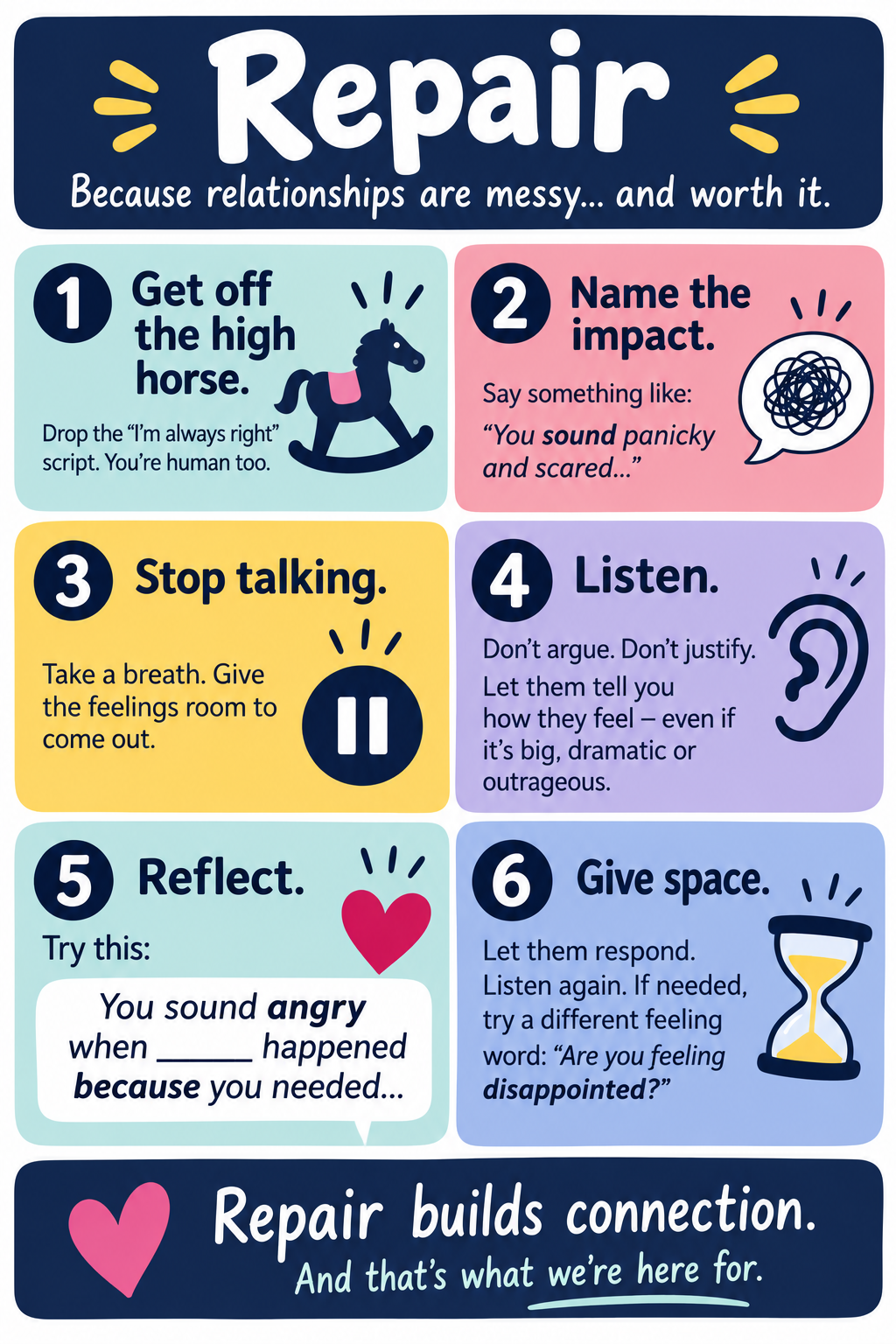
Repair isn't something parents do perfectly, it's something humans do to protect belonging through disagreements.
A child can learn that we survive mistakes, feelings can be expressed without losing connection, and people can take responsibility for their impact without imploding, exploding or losing everything... by experiencing it.